 Skip to main contentSkip to footer




Gardening Resources

Rabbit info:
http://www.ext.nodak.edu/extnews/hortiscope/pests/rabbit.htm
Deer info:
http://www.ext.nodak.edu/extnews/hortiscope/pests/deer.htm
Garden info:
http://www.ext.nodak.edu/extnews/hortiscope/contents.htm
~~~~~~~~~~~~~~~~~~~~~~~~~~~~~~~~~~~~~~~~~~~~~~~~
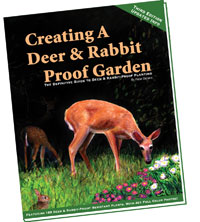
Creating A Deer & Rabbit Proof Garden
the definitive book for creating a deer proof garden.
Creating A Deer & Rabbit Proof Garden, is the last reference you’ll ever need in order to own a worry free garden! It’s the final word on selecting plants and creating a landscape that will not ring the dinner bell for deer.Much more than a simple list of plants, the best use for each plant is explained, exactly where to plant them for the best results, the ultimate height and spread of each plant and how to care for them.
Spectacular photographs show you in great detail, what each plant looks like. Many plants feature 5 full color photographs, showing you all 4 seasons of glory.
This book is a truly unique design and concept.
* 144 pages
* 255 full color photographs
~~~~~~~~~~~~~~~~~~~~~~~~~~~~~~~~~~~~~~~~~~~~~~~~
Managing White-Tailed Deer
in Suburban Environments
A Technical Guide
Anthony J. DeNicola, Kurt C. VerCauteren, Paul D. Curtis, and Scott E. Hygnstrom
A publication of Cornell Cooperative Extension, the Wildlife Society- Wildlife Damage Management Working Group, and the Northeast Wildlife Damage Research and Outreach Cooperative
(note to reader) The following is an edited extract of the Techinical Guide.
Repellents
Repellents are best suited for use in orchards, nurseries, gardens, and on ornamentals or other high-value plants. High application cost, label restrictions on use, and variable effectiveness make most repellents impractical for row crops, pastures, or other low-value commodities. Success with repellents is measured in reduction of damage; total elimination of damage should not be expected (Craven and Hygnstrom 1994).
Repellents work by reducing the attractiveness and palatability of treated plants to a level lower than that for other available forage. Repellents are more effective on less palatable plant species than for those that are highly preferred (Swihart et al. 1991). Effectiveness also depends on the availability of alternate forage (Conover 1987, Conover and Kania 1988, Andelt et al. 1991), and repellent performance seems to be negatively correlated with deer density.
Repellents have traditionally been classified as odor or taste-based products. Examples of odor-based repellents include products containing rotten eggs, soap, predator urine, blood meal, and other animal parts.
The primary advantage of odor-based products is that deer usually realize the plants are treated when they approach within a few feet, so the plants remain undamaged.
Taste-based repellents are sprayed or dusted on the foliage to protect plants from deer browsing. Examples of these materials include hot sauce (contains capsaicin, the active ingredient in hot peppers) and thiram. The primary disadvantage of taste-based products is that deer must sample and damage the vegetation before they are affected by the repellent.
More recently, scientists have classified repellents by four specific modes of action: fear, conditioned aversion, pain, and taste (Beauchamp 1997, Mason 1997). Fear-inducing repellents emit sulfurous odors that mimic predator scents. Conditioned aversion is an avoidance response associated with a treated item and an illness. Pain-inducing repellents affect the trigeminal receptors located in the mucous membranes of the eyes, nose, mouth, and throat. Taste repellents generally include a bitter agent that makes treated items unpalatable.
In addition to mode of action, several other factors that influence the effectiveness of repellents must be considered. Some repellents weather poorly, so it is usually best to use products that contain a commercial “sticker” or adherent. Also, repellents only protect the foliage to which they are applied. New growth that emerges after the application of the treatment is unprotected(Allan et al. 1984). Therefore, repellents have to be reapplied repeatedly during the growing season to retain their effectiveness(Sullivan et al. 1985, DeYoe and Schapp 1987, Andelt et al. 1991). For peak efficacy, many repellents should be reapplied every four to five weeks as long as deer-feeding pressure remains high (Sayre and Richmond 1992).
Many deer repellents have been evaluated in the scientific literature (Palmer et al. 1985, El Hani and Conover 1997, Wagner and Nolte 2000). Commercial repellents do not perform equally, and research has indicated that odor-based products often out-perform taste-based materials. Always follow label instructions for appropriate application.
note: The source document (56 pages in .pdf format) of this extract can be found at:
http://wildlifecontrol.info/pubs/Documents/Deer/Deer_management_mechs.pdf
We also recommend:
The Internet Center for Wildlife Damage Management – a non-profit, grant funded site that provides research-based information on how to responsibly handle wildlife damage problems.
~~~~~~~~~~~~~~~~~~~~~~~~~~~~~~~~~~~~~~~~
MASTER GARDENERS – FREE SAMPLES for Master Gardener events.
Call our promotions manager using our Toll Free Number 1-800-252-6051 and we can provide you with FREE Plantskydd Deer & Rabbit Repellent to use as door-prize promotions for your next meeting, conference, or event. (Be advised-TW will conduct ‘due diligence’ prior to shipping product.)